Practical AI for Business
AI Agent Frameworks or Custom Code? The Real Question Is What You Want to Own
Compare AI agent frameworks, managed platforms, and custom agents across security, compliance, maintenance, control, and long-term ownership.
An AI agent can do more than answer a question. It can gather information, choose between steps, use software tools, update records, draft communications, and ask a person for approval before taking action.
That makes agents potentially useful. It also makes them more complicated than an ordinary chatbot.
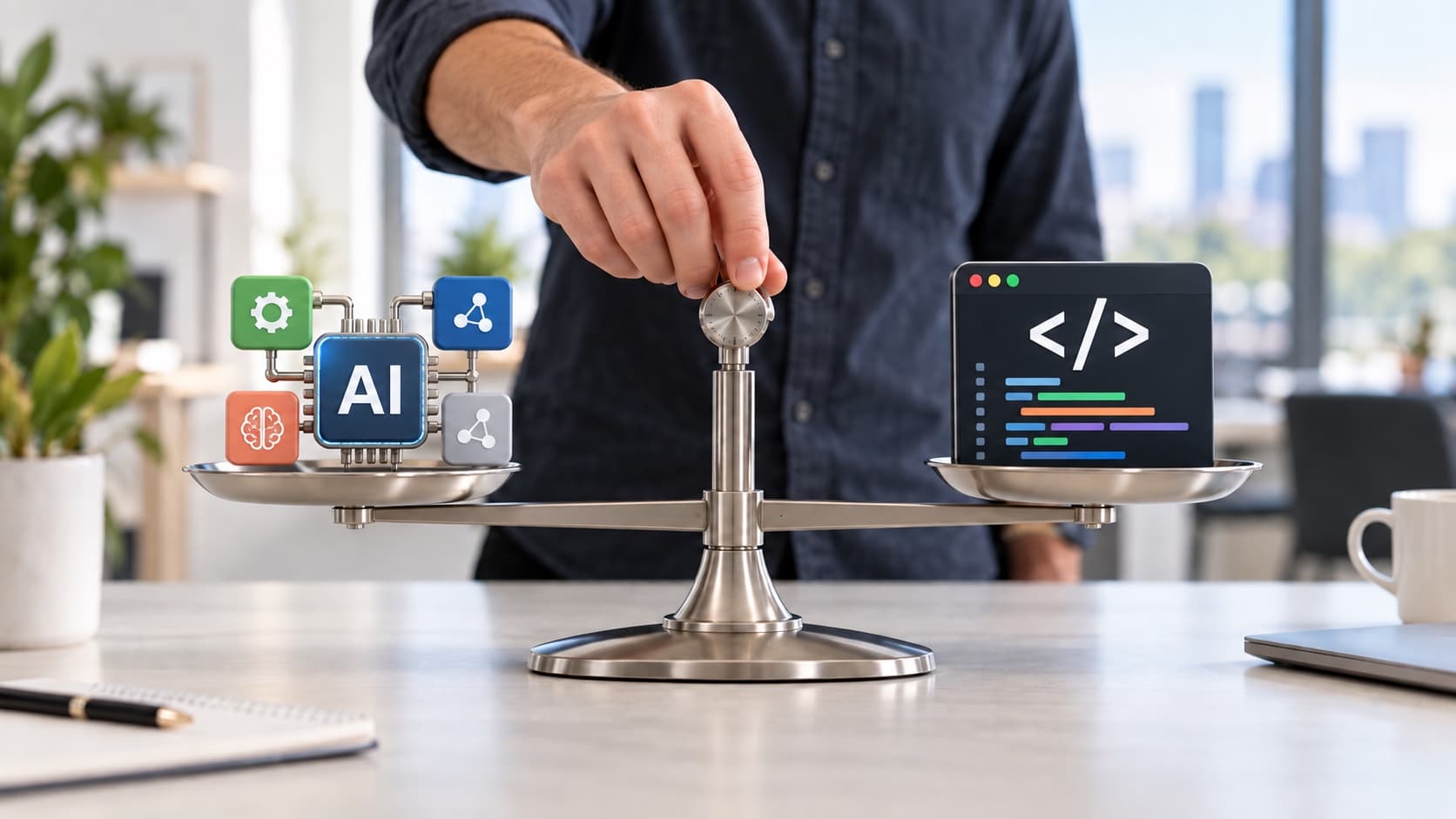
When a business decides to build one, an early question is whether to use an established framework such as CrewAI or LangGraph, or create a bespoke agent from the ground up.
CrewAI and LangChain/LangGraph are only two examples in a much larger and fast-changing field. Other options include Microsoft Agent Framework, which Microsoft describes as the successor to AutoGen and Semantic Kernel; Google's Agent Development Kit; the OpenAI Agents SDK and managed Agents API; Amazon Bedrock AgentCore; LlamaIndex AgentWorkflow; and Pydantic AI. Some are open-source development frameworks, some include managed infrastructure, and some are closely connected to a particular cloud or model provider.
Throughout this article, we will use CrewAI and LangChain/LangGraph as working examples because they illustrate the architectural choices clearly. The larger point is not that these two products are always the right answer. The same questions about control, compliance, security, maintenance, and ownership apply across the wider agent-infrastructure market.
The most useful answer is usually neither extreme.
A business may need a custom agent because its process, rules, data, and customer experience are unique. But that does not mean it should also build its own system for workflow state, retries, logging, human approvals, evaluations, deployment, and monitoring.
The real decision is not simply framework versus custom. It is: Which parts of this system give us a competitive advantage, and which parts are an ongoing technical responsibility we would rather not own alone?
That question becomes especially important when the agent will handle sensitive data, communicate with customers, change business records, or take actions that someone may later need to explain.
What is an AI agent framework?
An agent framework is a collection of software building blocks for creating and operating AI workflows.
The AI model may still come from OpenAI, Anthropic, Google, or another provider. The framework helps control which step runs next, which tools the agent may use, what information is remembered, what happens when a tool fails, where a person must approve an action, how a paused task resumes, what gets logged for review, and how different versions are tested.
CrewAI and LangGraph approach this problem differently.
CrewAI uses the idea of specialized agents working together in a crew. It also provides Flows for more structured, event-driven processes. CrewAI's own documentation recommends its more autonomous Crews for open-ended work and its structured Flows when a process needs predictable routing, auditability, and precise control.
LangGraph represents a workflow as a graph made of steps, decisions, and shared state. It is designed to make the path through a process explicit. It also supports checkpoints, retries, human interruptions, and resuming work after a pause or failure. LangChain provides a broader collection of AI components, while LangSmith adds testing, tracing, monitoring, deployment, and other production capabilities.
These systems can save considerable development time. They do not eliminate the need for custom thinking.
A custom agent is not necessarily built from scratch
The word bespoke can be misleading.
Almost every business agent is custom in some respect. It may reflect a company's approval policy, customer records, writing style, pricing rules, or internal process. Those are exactly the areas where customization matters.
But even a fully customized application will usually depend on outside components: a model provider, cloud service, database, authentication system, email service, and software libraries.
The practical choices are to build most orchestration yourself using ordinary application code; build custom business logic on an open-source framework; use a framework with managed deployment and monitoring; or combine those approaches while keeping sensitive or differentiating components under direct control.
For many businesses, the combined approach is the most sensible.
Why established frameworks can reduce operational risk
Imagine an agent that helps manage customer support email.
It reads a message, identifies the issue, looks up approved information, drafts a response, and routes refund requests to a person before anything is sent.
The visible task sounds simple. The production requirements are not.
What happens if the customer database is temporarily unavailable? Can the agent retry without sending two replies? If the process pauses for approval, can it safely resume the next day? Can a manager see which source material informed the response? Can the company reconstruct what happened if a customer disputes the result?
A mature framework may already provide patterns for state, retries, checkpoints, tracing, evaluation, and human review. A managed platform may also provide deployment controls, infrastructure monitoring, security documentation, and a defined vulnerability-reporting process.
This does not make the resulting agent automatically safe or compliant. It does mean the development team does not have to invent every operational mechanism independently.
That distinction matters. Reusing a maintained capability can reduce duplicated engineering work and make important controls easier to apply consistently.
Compliance requires evidence, not a reassuring label
Businesses sometimes assume that using an enterprise or compliant AI platform makes their application compliant.
It does not.
A vendor's SOC 2 report, ISO certification, HIPAA offering, or other assurance applies to a defined scope. It can provide useful evidence about the vendor's own controls. It does not automatically cover the way your organization configures the agent, chooses data, grants permissions, retains logs, or uses the output.
For example, LangChain publishes a Trust Center for LangSmith that includes information about its compliance posture, audit reports, infrastructure controls, and subprocessors. That information can support vendor review. The business still needs to determine whether its particular deployment, data flow, retention settings, and contracts satisfy its obligations.
This is one place where a managed platform may have a practical advantage over a collection of undocumented custom components. Security teams and customers can review an established control environment instead of relying entirely on promises from the development team.
But the responsibility is shared. The platform secures its portion. The business remains responsible for its data, workflow, permissions, policies, and use.
Safety comes from limiting what the agent can do
An agent becomes riskier when it can take actions, not merely write suggestions.
An agent that drafts a refund response is different from an agent that can issue the refund. An agent that summarizes a contract is different from one that can accept terms. An agent that identifies a possible scheduling conflict is different from one that can cancel an appointment.
Useful safety controls include giving the agent only the minimum permissions it needs, separating analysis from action, requiring human approval for consequential steps, restricting which tools and records it may access, validating inputs and outputs, recording what the agent did and why, and providing a way to stop or disable the workflow.
Frameworks can make these controls easier to implement. LangGraph, for example, treats human interruption and resumption as part of the workflow. CrewAI distinguishes autonomous agent collaboration from more structured Flows intended for controlled processes.
The framework supplies mechanisms. People still have to decide where the boundaries belong.
That is why human judgment remains the real AI advantage, especially when an automated system can affect customers, money, access, or sensitive information.
Maintenance may be the strongest argument for using a framework
The cost of an agent is not limited to building the first version.
Models change. Provider APIs change. Authentication methods evolve. Dependencies disclose vulnerabilities. Business rules change. A new model may produce better results on one task and worse results on another. An update to one component can change the behavior of the entire workflow.
A completely custom orchestration system leaves the organization responsible for tracking and repairing all of that machinery.
An open-source framework can shift part of the burden to a larger maintenance community. When a defect or vulnerability is corrected upstream, the organization may be able to adopt the patch instead of designing its own. But someone still has to monitor releases, update the dependency, run tests, and confirm that the workflow did not regress.
A managed service shifts more infrastructure maintenance to the provider. It may handle platform deployment, scaling, monitoring, and some security patching. The organization still owns its custom code, prompts, integrations, model choices, and acceptance testing.
Open source can provide the patch. A managed platform may apply more of the patch. Neither one proves that your agent still behaves correctly afterward.
That is why evaluation matters. LangSmith, for example, supports pre-deployment tests, regression comparisons, production monitoring, and turning failed production runs into future test cases. Those capabilities are valuable because AI behavior cannot be judged only by whether the software started successfully.
The trade-offs are real
Frameworks and managed services introduce their own risks.
They add dependencies. Their interfaces can change. A managed service may create cost, data-location, telemetry, or vendor-lock-in concerns. A broad framework may be unnecessary for a simple workflow. Every additional component expands the system that must be understood and secured.
For a small, deterministic task, ordinary code may be the safer choice.
Consider a process that sends a document to one model, receives a structured classification, validates the response, and places it in a review queue. A full multi-agent framework may add complexity without adding meaningful protection.
By contrast, a long-running workflow with several tools, branching decisions, state, approvals, and failure recovery is exactly where established orchestration can earn its place.
The mature decision is not to use the most sophisticated technology available. It is to use the least complicated architecture that can satisfy the business and risk requirements.
A practical decision framework
Before choosing CrewAI, LangGraph, another platform, or a custom implementation, answer these questions:
1. What happens if the agent is wrong? If the result is an internal brainstorming note, a lightweight solution may be enough. If it affects money, customers, access, legal rights, health, employment, or confidential data, stronger controls and evidence are needed.
2. Does the workflow need to pause and resume? Long-running tasks, human approvals, and recovery after failure favor systems with durable state and explicit checkpoints.
3. Must we explain what happened later? If a manager, customer, auditor, or regulator may ask why the system acted, tracing, version records, source records, and approval history need to be designed from the beginning.
4. Where will sensitive data travel? Map every provider, database, log, trace, and subprocessor. Decide what can be stored, for how long, in which region, and who can retrieve it.
5. Who owns updates and incidents? Name the person or provider responsible for monitoring releases, reviewing vulnerabilities, applying patches, testing behavior, and responding when the agent fails.
6. Can we leave the platform later? Understand which parts use portable code and data, and which depend on proprietary deployment, observability, or workflow features.
7. Are we adding autonomy where structure would work better? Not every workflow needs a team of agents deciding what to do next. Many business processes benefit from a structured flow with limited AI judgment inside clearly defined steps.
The most practical answer is usually a controlled hybrid
For most businesses, the strongest architecture will keep the company's distinctive process custom while relying on maintained components for common infrastructure.
That can mean custom rules for acceptable results, custom integrations with the systems the business actually uses, a framework for state and routing, managed or internally operated deployment and observability, independent controls for identity and data retention, and human judgment at consequential decision points.
This approach does not remove risk. It makes ownership clearer.
NIST's AI Risk Management Framework organizes AI risk work around four continuing activities: govern, map, measure, and manage. That is a useful reminder that safety is not a feature installed once. It is a lifecycle.
The right framework can support that lifecycle. It cannot replace it.
Start with the workflow, not the framework
CrewAI and LangGraph are capable tools, but a tool comparison should not be the first step.
Start by mapping the actual business process. Identify the data involved, the decisions being made, the systems the agent may touch, the consequences of a mistake, and the points where a person should remain in control.
Then decide what deserves custom development and what should rest on maintained infrastructure.
That is the deeper case for using an established agent framework or managed service. It is not simply that development may be faster. It is that the organization can spend more of its effort on the business problem while using tested patterns for the operational responsibilities surrounding it.
And when custom code is the better answer, the same discipline still applies: clear permissions, observable behavior, human oversight, regression testing, and an explicit maintenance owner.
If your organization is considering an agent, begin by identifying the right workflow and its real risks before choosing the technology. An AI Opportunity Report can help clarify where AI may create value, what should remain human-led, and what questions should be answered before anything is built.
Sources
- Microsoft: Agent Framework documentation
- Google: Agent Development Kit
- OpenAI: Agents SDK
- Amazon Web Services: Amazon Bedrock AgentCore
- LlamaIndex: Agents and AgentWorkflow
- Pydantic: Pydantic AI
- CrewAI: Framework introduction
- CrewAI: Agent Management Platform
- LangChain: Thinking in LangGraph
- LangChain: LangSmith evaluation types
- LangChain: LangSmith Security Hub
- NIST: AI Risk Management Framework
- NIST: Generative AI Profile
Considering an AI agent?
The AIQ Opportunity Report helps identify where AI may create practical value, what should remain human-led, and which risks need to be addressed before anything is built.
Explore the AI Opportunity Report