
Practical AI for Business
The Companies That Rushed to Replace People With AI Are Learning a Hard Lesson
Some companies rushed to replace workers with AI. The better lesson is that AI works best when it supports people, judgment, and practical workflows.
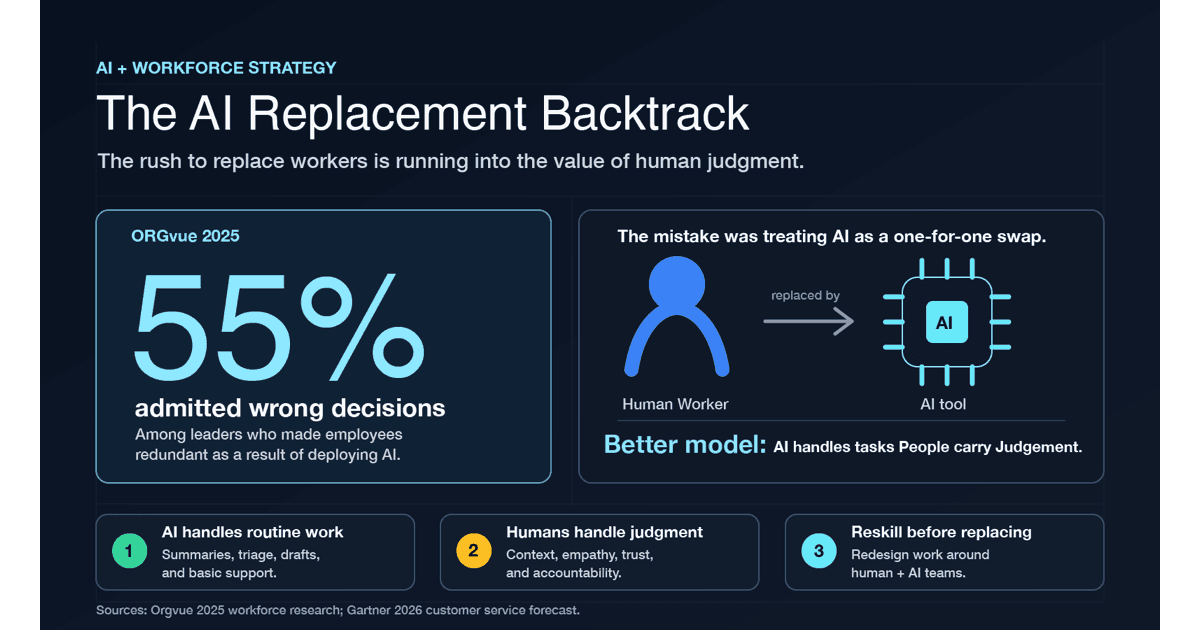
Some companies moved too quickly from "AI can help our team" to "AI can replace our team."
That leap is where the trouble started.
Artificial intelligence can be extremely useful. It can summarize long documents, draft first versions, answer routine questions, organize information, write code, compare options, and help people move faster through repetitive work. Used well, it can make a small team feel more capable and give busy workers time back.
But a job is not just a list of tasks.
A job also includes judgment. Context. Relationships. Timing. Taste. Accountability. The ability to notice when something feels off. The ability to decide when the standard answer is not good enough.
That is the lesson many businesses are starting to learn. AI can replace pieces of work. It does not automatically replace the full value of the worker.
Why this matters now
The first wave of generative AI adoption created a rush of excitement. Leaders saw tools that could write, respond, classify, summarize, translate, and analyze at a speed no human team could match.
It was natural for executives to ask a cost-cutting question: "How many roles can this replace?"
But that was often the wrong first question.
A better question is: "Which parts of our work can AI handle so our people can spend more time on the work that actually needs human judgment?"
That difference matters. One question treats AI as a replacement strategy. The other treats AI as a capability strategy.
The companies that get this right will not simply have fewer people. They will have better-equipped people.
The replacement mistake
Klarna became one of the most visible examples of the AI replacement story.
In early 2024, the financial technology company announced that its AI assistant was handling two-thirds of its customer service chats after its first month. Klarna said the assistant was doing work equivalent to 700 full-time agents and projected a major profit improvement from the tool.
Those numbers got attention for an understandable reason. Customer service is expensive, repetitive, and often hard to staff. If AI could handle a large share of routine support requests, that would be valuable.
And to be fair, that part of the story is real. AI can be useful in customer service. It can answer common questions, route requests, find policy information, translate responses, summarize prior interactions, and help human agents move faster.
The problem comes when leaders mistake "AI can handle many customer service tasks" for "AI can replace the full customer service function."
Customers do not only need answers. Sometimes they need reassurance. Sometimes they need someone to understand why a simple policy answer does not fit a complicated situation. Sometimes they need a human being who can decide that a case should be escalated.
By 2025, Klarna's message had shifted. Its CEO, Sebastian Siemiatkowski, said the company still believed strongly in AI, but also emphasized that human customer service would remain important, especially for higher-touch situations.
That is the more useful lesson. The issue was not that AI had no place. The issue was assuming too much, too quickly.
What companies forgot to measure
The easiest work to measure is often not the most important work.
A dashboard can show how many tickets were closed. It can show average response time. It can show how many chats were handled without a human. Those numbers matter, but they do not tell the whole story.
They may not show whether a frustrated customer felt heard.
They may not show whether a refund decision required discretion.
They may not show whether a long-time client was about to leave.
They may not show whether an experienced employee noticed a small quality problem before it became an expensive one.
This is where the replacement mindset breaks down. Many companies underestimated the invisible work their employees were doing every day.
People carry institutional memory. They remember which client had a bad experience last month. They know which supplier tends to miss details. They recognize when a request sounds routine but is actually risky. They understand the tone, history, and expectations around the work.
AI can support that work. It can make it faster. It can surface useful information. But it needs people who know what good looks like.
The evidence points toward augmentation
This is not just a feeling. Research and workforce data point in the same direction.
The International Labour Organization found that generative AI is more likely to augment jobs than destroy them outright, because most jobs are only partly exposed to automation. In plain English: AI can take over some tasks inside a job, but that does not mean it can take over the whole job.
Orgvue's 2025 research found that some business leaders who made workers redundant because of AI later admitted those decisions were wrong. The same research also found that many leaders planned to reskill employees so they could use AI more effectively.
Gartner has predicted that by 2027, half of companies that cut customer service staff because of AI will rehire people for similar work, though often under different job titles. Gartner's analysts also noted that AI is not yet mature enough to fully replace the expertise, empathy, and judgment human agents provide.
There is also strong evidence that AI can help workers perform better when it is used as an assistant. A National Bureau of Economic Research study of more than 5,000 customer support agents found that access to a generative AI assistant increased productivity by 14% on average, with the largest gains for newer or less experienced workers.
That is an important distinction. AI was not replacing those workers in the study. It was helping them do the job better.
Salesforce's lesson: redesign the work
Salesforce offers a different version of the lesson.
After using Agentforce to handle routine customer support work, Salesforce says it redeployed hundreds of support engineers into higher-growth areas of the business rather than treating those employees as disposable.
Salesforce frames the approach as redesigning work, reskilling people, redeploying talent, and rebalancing the partnership between agents and humans.
That example matters because it shows a more practical path than simply cutting people first and asking questions later.
When support work changes, the people who understand the customers, products, failure patterns, and internal systems can become more valuable, not less. They can help improve AI systems, support higher-value customer work, train newer employees, and move into roles where their judgment matters more.
Salesforce also makes a point more companies should study: the cost of keeping people and their knowledge is often less than the cost of letting them go.
That is a better model for AI adoption. Redesign the work. Reskill the people. Use AI to move human talent toward higher-value problems.
AI is better as a power tool than a pink slip
The practical opportunity is not to choose between humans and AI.
The opportunity is to redesign work so each does what it does best.
AI is well suited for routine, repeatable, information-heavy tasks such as drafting first versions of emails or documents, summarizing meeting notes, sorting customer requests by topic, finding patterns in large amounts of text, creating checklists, translating basic content, comparing options, answering common internal questions, and helping employees prepare for calls, meetings, or projects.
People are still essential for work that requires judgment, trust, empathy, accountability, strategy, creativity, ethics, negotiation, relationship memory, and understanding what is not being said.
The smartest use of AI is not to remove people from the process. It is to remove some of the friction around them.
Let AI produce the first draft. Let the person shape the message.
Let AI summarize the customer history. Let the person decide what the customer needs next.
Let AI flag the anomaly. Let the expert judge whether it matters.
Let AI help train newer workers. Let experienced workers define what quality means.
That is where AI becomes powerful. Not as a substitute for human capability, but as a multiplier of it.
What this means for workers
If you are worried about AI, the answer is not to ignore it.
The better answer is to learn how to work with it.
That does not mean you need to become a programmer. It does not mean you need to understand every technical detail. For most people, the practical skill is learning how to use AI as a thinking partner and work assistant.
Can it help you prepare for a meeting?
Can it turn a messy note into a clear summary?
Can it help you compare three options?
Can it help you draft a polite response when you are short on time?
Can it help you find the questions you should ask before making a decision?
Workers who combine real-world experience with basic AI fluency will be in a stronger position than workers who have only one of those things.
The goal is not to compete with AI at what AI does well. The goal is to use AI so you can spend more time doing what people do best.
What this means for business owners
For business owners and leaders, the lesson is straightforward: do not start with layoffs. Start with work mapping.
Before you remove a role, understand what that role actually does.
What tasks are repetitive?
What tasks require judgment?
What customer relationships depend on that person?
What knowledge lives in that person's head but not in your systems?
What could go wrong if AI handles the task incorrectly?
What human review is needed?
What training would help the employee use AI well?
A responsible AI strategy should improve the business without casually discarding the people who understand the business.
Start with a pilot. Measure quality, not just speed. Keep humans in the loop for high-stakes work. Train employees before judging whether AI is "working." Be honest with your team about what is changing and why.
Most of all, remember that AI adoption is not only a technology project. It is a people project.
The better future is human plus AI
AI is not going away. It will continue to change how people write, research, serve customers, manage operations, analyze information, and make decisions.
That change can be stressful. It can also be useful.
The companies learning the hard lesson now are not proving that AI is a failure. They are proving that the replacement mindset is too simple.
AI works best when it powers workers.
It can clear routine work off the desk. It can make information easier to use. It can help newer employees learn faster. It can give experienced employees better tools. It can help small teams do work that once required much larger teams.
But it still needs people who know the customer, understand the work, ask better questions, and take responsibility for the outcome.
The future of work is not humans versus AI.
The better future is humans using AI well.
For any business wondering where to begin, start small. Pick one workflow where your team loses time every week. Use AI to make that workflow easier. Let your people test it, improve it, and decide where it helps.
That is how trust is built. That is how capability grows. And that is how AI becomes what it should have been from the beginning: a practical tool that helps people do better work.
Sources
- International Labour Organization: Generative AI likely to augment rather than destroy jobs
- Orgvue: Businesses admit wrong redundancy decisions after bringing AI into the workforce
- Gartner: Companies that cut customer service staff due to AI may rehire by 2027
- Klarna: AI assistant handles two-thirds of customer service chats in its first month
- TechCrunch: Klarna CEO says company will use humans to offer VIP customer service
- NBER: Generative AI at Work
- Salesforce: How Salesforce Is Reimagining Its Workforce for the Agentic Enterprise
- Salesforce: How Salesforce Is Reshaping Its Workforce in the Age of AI
Want to find one practical AI workflow?
An AIQ Opportunity Report helps identify where AI can support your team before treating AI as a staffing strategy.
Request an AIQ Opportunity Report